
-
Home

-
About Us
-
Blog
-
Barry Nolan's blog posts
- August 2014

Financial Protection
We know that your holiday will be one of the most important investments you make in a year and we understand how important it is for you to know that you are financially protected and that your money is secure.
We understand how important it is for you to know that you are financially protected and that your money is secure.
The British Travel Industry is strictly governed and so there are many factors in place to ensure that your holiday experience and your finances are protected.
Many of our holidays include flights and these always depart from the UK. If your holiday is flight inclusive, then it is protected under our ATOL license (License number 6865).
If you are a fulltime UK resident and you book a ‘land only’ (i.e. a non-flight inclusive package where you arrange your own flights) then your money is protected through our ABTA bonding (ABTA number Y6261).
We are very happy to arrange holidays for people located anywhere in the world. The vast majority of non-UK residents arrange their own travel to the UK and make a booking with for a flight inclusive package departing from the UK for convenience but also to benefit from our financial protection. If you would like to arrange your own flights directly to your chosen holiday destination then this would not be covered by our ATOL financial protection and you would need to ensure your travel insurance provides sufficient cover for your needs. This does not affect our booking terms and conditions.
We are also members of AITO (Association of Independent Tour Operators) and abide by their terms of membership.
Additional information from the CAA relating to our ATOL license:
We hold an Air Travel Organiser's License issued by the Civil Aviation Authority (ATOL number 6865). When you buy an ATOL protected flight or flight inclusive holiday* from us, you will receive an ATOL Certificate.
This lists what is financially protected, where you can get information from and who to contact if things go wrong. We, or the suppliers identified on your ATOL Certificate, will provide you with the services listed on the ATOL Certificate (or a suitable alternative).
In some cases, where neither we nor the supplier are able to do so for reasons of insolvency, an alternative ATOL holder may provide you with services you have bought or a suitable alternative (at no extra cost to you). You agree to accept that in those circumstances the alternative ATOL holder will perform those obligations and you agree to pay any money outstanding to be paid by you under your contract to that alternative ATOL holder. However, you also agree that in some cases it will not be possible to appoint an alternative ATOL holder, in which case you will be entitled to make a claim under the ATOL scheme (or your credit card issuer where applicable). If we, or the suppliers identified on your ATOL certificate, are unable to provide the services listed (or a suitable alternative, through an alternative ATOL holder or otherwise) for reasons of insolvency, the Trustees of the Air Travel Trust may make a payment to (or confer a benefit on) you under the ATOL scheme. You agree that in return for such a payment or benefit, you assign absolutely to those Trustees any claims which you have or may have arising out of or relating to the non-provision of the services, including any claim against us, the travel agent or your credit card issuer where applicable. You also agree that any such claims may be re-assigned to another body, if that other body has paid sums you have claimed under the ATOL scheme.
*Many of the flights and flight-inclusive holidays on this website are financially protected by the ATOL scheme. But ATOL protection does not apply to all holiday and travel services listed on this website. Please ask us to confirm what protection may apply to your booking. If you do not receive an ATOL Certificate then the booking will not be ATOL protected. If you do receive an ATOL Certificate but all the parts of your trip are not listed on it, those parts will not be ATOL protected. Please see our booking conditions for information, or for more information about financial protection and the ATOL Certificate go to: www.atol.org.uk/atolcertificate.
If you have any questions relating to financial protection, please do not hesitate to contact us as this is an area we have extensive knowledge and expertise. We will be more than happy to discuss and take you through any concerns that you may have.
RESPONSIBLE TRAVEL
Artisan Travel is part of The Artisan Travel Company (our parent company). Right from the beginning all the way back in 2002 we have held strong beliefs and a keen focus on responsible tourism.
Our Responsible Tourism Policy is outlined below and puts on paper what we implement across our business. The policy is always under review and amended in line with best practice. Whilst we do our very best with the resources that we have, we always know that there is more to be done to make our operations both at home and overseas as responsible as possible.
This policy is always available to our guests and it is issued to all of our suppliers in order to ensure that the core principles are adhered to and upheld throughout our supply chain and that our clients are aware of our stance on certain practices etc.
Our policy is divided into three primary sections: social, economic and environmental responsibility.
It is important to outline here the general approach which The Artisan Travel Company takes to responsible tourism. It is based on the theory of the triple bottom line, a phrase coined by John Elkington a world leading authority on corporate responsibility.
In short the triple bottom line is where the profitability of the company and the positive economic impact of our holidays in a destination is as equally valued as the company's environmental and social performance. Where many tour operators may well simply quote Elkington as a tick box in a policy we endeavor to provide tangible evidence that we are putting this into action. Responsible tourism is at the core of what we do.
As an independently owned company we have the luxury of being able to determine our own priorities and our own bench marks for success and have the ability to ensure that this ethos is central to everything we do.
Social Responsibility
Firstly we ensure that wherever possible we use local guides, local transport providers and locally owned accommodation providers. This gives our clients a much more intimate relationship with the destination in which they are visiting, provides local people with employment and ensures that wherever possible the economic benefits of the tourists' visits are received in the local communities. We do not want this money to act as compensation to the communities for our clients' visits, but as payment for excellent services provided. We also hope that by helping to provide local employment we will also be helping to preserve remote communities where otherwise younger generations may tend to move towards larger urban areas for work.
Importantly we feel very strongly that the local guides in particular are better qualified than anyone to talk about the destinations in which they work and to operate within a region which they know like the back of their hands. These factors both enable them to take pride in the area they work as well as improving safety levels in many of the activities as the guides generally have years of experience rather than weeks. In some destinations you may encounter some expatriate Britons but they live and work within these regions and have invested heavily in the destination.
- We also ensure that throughout our operations anyone involved with The Artisan Travel Company:
- Has a safe and clean environment in which to work
- Is paid fairly for their work
- Is not given an unreasonable amount of work
- Is treated with respect and equality by all clients and members of staff
- Is not discriminated against for reasons of colour, race, gender, religion or disability
We want to ensure that our clients get the best possible experience and so it is vital for us to develop long term and successful partnerships with suppliers that are productive and fair for all parties involved.
Economic Responsibility
We always utilise locally owned accommodation and activity providers wherever possible. We like to stay off the beaten track and provide a more unique experience for clients so this all goes hand in hand.
Wherever possible we try to avoid using large hotel chains as we want the money generated by tourism within a region to remain within the region rather than leaking overseas.
The areas in which we operate tend to be rural and so employment opportunities can be more limited than in larger towns. A local hotel can provide a vital source of employment in a town and help stem the flow of people from these communities to urban environments. In turn this helps to sustain the economies of small rural towns. We ensure that wherever possible our accommodation providers and activity guides source produce locally when meals are included and if not then we recommend local restaurants to clients. We want to utilise the tourism multiplier effect wherever possible in order to widen the economic benefit of our presence.
When it comes to souvenirs we will always try to inform clients of some of the locally produced handicrafts to look out for and try and encourage them to purchase goods from the region if they wish to take something home. We also ensure that we discourage the removal of natural souvenirs such as shells etc. Our clients are informed about souvenir trades that may be detrimental to the environment or that perhaps do not provide their workers with appropriate working conditions.
In some countries we feature; bargaining for goods is the local custom and we give guidelines to clients to help them negotiate prices which are both fair to them and the seller. We discourage any form of aggressive haggling.
By ensuring that the economic benefits (wherever possible) are felt by the people in the areas in which our holidays operate then we improve our relationships and show our commitment to a destination. This in turn enables us to improve the experiences in a destination as this mutual cooperation fosters excellent working relationships.
Environmental Responsibility
This is the section that most people will associate most strongly with responsible tourism and it is certainly the most high profile area.
Tourism and the environment must be managed and the relationship monitored. It is something which we take into account throughout the planning, the operation and the evaluation of a holiday.
Firstly we are a niche operator; we do not send hundreds of clients into one destination during a week. It is not the way in which we operate, nor will it ever be. Large groups are not conducive to successful and high quality holidays and during our small group holidays the group size is always made appropriate to the nature of the environment and the proximity of our guests to the local population. We do not want local people to feel they have been invaded!
We work in remote areas and in many places which can only be described as pristine wildernesses. The impact of unmanaged tourism in these areas can be wholly detrimental
Working with local people obviously provides us with a huge advantage in this respect. Our guides' pride in the regions is always tangible and they ensure that the 'leave no trace' ethos is continually expressed to clients and visibly implemented during the activities.
When we plan our holidays we do so with the environment in mind. We deliberately leave out certain activities if we feel that their impact on the environment is to its detriment. The group sizes which we offer are designed with our clients’ experience in mind as well as the likely impact on a natural area.
We assess a hotel's facilities with regards to the environment and have developed an audit to enable us to document the processes and facilities in places in each of our hotels with greater accuracy and in order to help provide our clients with further information.
Where possible we always include group transportation. Not only is this obviously more economical for clients but it reduces emissions. We also ask clients to consider the use of public transport such as trains and buses on their free days (when available).
When planning hotels we ensure that we familiarise ourselves with all means of arriving in a destination, whether by train, sea or by road. When flights are involved we encourage clients to offset the emissions caused – in fact we encourage this for all methods of transport.
We dedicate additional time and money to ensuring that the impacts of our holidays are positive and that the environments we operate in remain unspoiled by our presence.
Our Local Partners
Our overseas partners are integral to the creation and implementation of our holidays. Without them, we would have neither the input that makes our holidays all the more enriching nor the local knowledge which provides a real insight into the destination.
It's local knowledge which provides a real insight into a destination
Essentially, we work with independent businesses which employ people who are passionate about the place in which they live and are eager to share that passion. These are the guys who look after our clients while they are on holiday so naturally we are very picky about whom we choose to partner with.
We work with independent businesses which employ people who are passionate about the place in which they live and are eager to share that passion
You may have noticed that we call them partners rather than suppliers and that is how we like to think about our association. It’s not about hard-nosed penny pinching but a mutually beneficial working relationship that allows us, our partners and, most importantly, our clients to benefit fully.

At Artisan Travel, we take the guesswork out of planning your perfect escape. We've carefully researched every destination to craft seamless itineraries that take you away from the crowds to unique destinations, giving you the space to enjoy quality time as a family while experiencing the very best each place has to offer.
Sorry, we can't find the page you are looking for.
This is probably because the page doesn't exist any more, or you have typed something wrong in the address bar.
Alternatively, we have broken something and need to fix it...
Don't worry though, here are some handy links to get you back on your way:

My love of Iceland - part 3: A little bit of north, south and west
The final part of the week was a combination of the idyllic south shore and the island's northernmost city of Akureyri. First though, we went to the Snæfellsnes Peninsula, on the west of the island, the self-proclaimed 'Iceland in miniature' which has a little bit of everything else you will see across the island - waterfalls, beaches, lagoons and glaciers.
We stayed in Stykkishólmur, which is one of those ridiculously quaint fishing villages which speak of an easy way of traditional laid-back life.
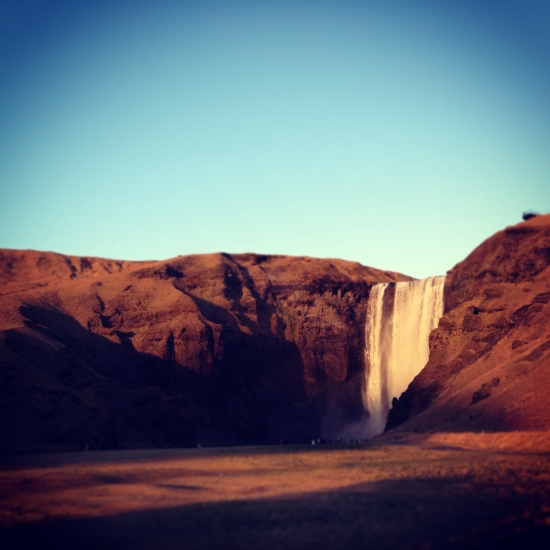
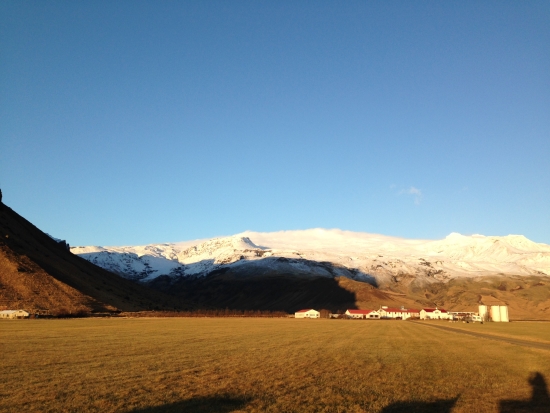
On the south shore we drive past glaciers and more waterfalls and the site of the infamous Eyjafjallajökull volcano. Here you can visit the tiny and informative museum which shows you the eruption in 2010 that not only impacted millions of air passengers across the globe but also completely covered the tiny community and farms here in vast quantities of ash.
My love of Iceland - Part 2: Adventures in the Blue Lagoon, Reykjavik and two thirds of the Golden Circle
When we arrived in Iceland, the first thing we did was drive to the Blue Lagoon. To get here you drive across unending black lava fields which many would find desolate, but to me had a sort of bleak beauty and it is really no exaggeration that I basically fell in love with the landscape at first sight - as overly dramatic as that sounds!
At the Blue Lagoon we changed into our swimwear and headed out to the water. I must admit the weather was pretty bad (I learned quickly that the best way to describe the weather in Iceland is 'wildly unpredictable...').
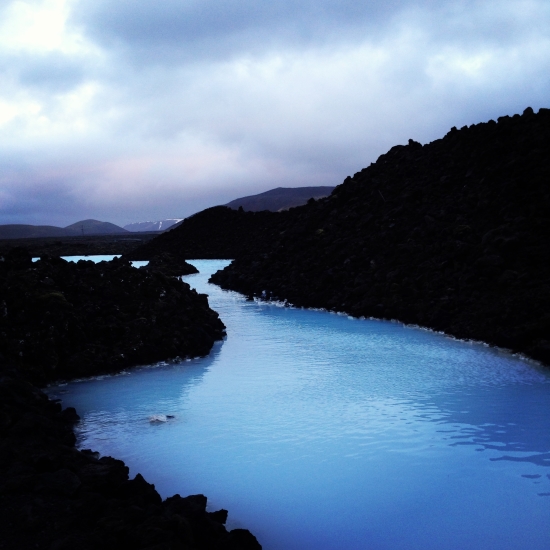
However, the milky blue water was toasty warm and as we floated around I was overwhelmed with the beauty of the place, with its pitch black lava backdrop against the blue of the water. It is well known as a tourist hotspot and I've heard some people say it's too busy and too commercial so I was a bit dubious but, it was quite simply wonderful. Yes, there are a lot of people there, but the lagoon is large enough that it never feels overcrowded and, as my very first taste of Iceland, it was pretty great. Speaking to fellow travellers the best times to go are early in the morning or late in the evening as it is much quieter then – late evenings in particular during the Midnight Sun are said to be rather special.
My very first memory of Iceland is seeing it on a travel programme as a child and being completely captivated. I couldn't quite tell you why – I think it planted itself in my 6 year old mind as this big frozen country – a mystical, otherworldly place in the middle of the sea that seemed so far from and so unlike anything else.
As strange as it sounds to most of my friends and family, I have never been a fan of hot places and whilst I appreciate a bit of sunshine every now and then it's the cold that I enjoy the most (I'm one of those people that enjoys when the English two week summer is done and I can get out my woolly jumpers again...) so Iceland, even by just its name, was a place that called out to me.
Since then I always wanted to visit and it was forever in the back of my mind as a sort of bucket list place that I knew I wanted to visit when I was a grown up (as far off as that seemed at the time).


 Travel Website Development